The Tribe at Work: Why Shared Intensity Creates Bonds We've Been Missing

It's a Tuesday morning a few months ago now, and I'm listening to a colleague describe a recent project sprint over a lukewarm flat white, gesturing with the kind of wistful energy most people reserve for gap-year stories. 'Those two weeks were intense,' she says, 'but I've never felt more connected to a team.' She's not describing a crisis. She's describing what work might become.
What struck me is that she wasn't nostalgic for the deliverables. She was nostalgic for the intensity. For the whiteboard sessions where ideas collided faster than anyone could type. For the shared exhaustion that somehow felt more meaningful than a hundred frictionless Teams messages. For the particular bond that forms when a group of people are genuinely in it together. The whole group walked away from that experience feeling inspired.
What's Actually Being Lost
This post introduces the ‘Tribal Intensity Principle’: shared struggle, not shared comfort, creates the workplace bonds we're missing. Master this, and you'll understand why your team feels hollow despite all the collaboration tools.
Unfortunately, most organisations are engineering belonging through the wrong mechanisms. Team-building events. Office mandates. Team channels for "watercooler chat." They're treating loneliness as a proximity problem when it's actually an intensity problem.
My take is that AI might accidentally solve any sense of workplace loneliness by making it worse first. The productivity pressure may push teams into sprint rhythms so intense they rediscover something ancient and deeply human.

The risk is that corporations mistake surface features for substance. Manufactured intensity without authentic stakes becomes performance theatre.
With that, let's dive in.
What Tribal Societies Understood About Bonding
Sebastian Junger's research on tribal belonging contains within it a puzzle. Junger's argument centres on a counterintuitive observation: humans thrive on hardship, specifically shared hardship with clear stakes. What they can't tolerate is feeling unnecessary.
Modern work has perfected the art of making people feel unnecessary. Gallup's 2024 report found one in five employees globally experience loneliness at work, rising to 25% for remote workers. A separate Cigna study found lonely workers significantly less willing to go above and beyond. We've built workplaces optimised for individual productivity and discovered humans aren't actually individuals.
Psychologist Brock Bastian's experiments found that physical discomfort serves as "social glue." Groups experiencing mild pain together showed higher cooperation than those sharing pleasant experiences. His conclusion: shared pain may be an important trigger for group formation. Although to be clear, I’m not suggesting we go around inflicting physical harm on each other (however tempted you might be after yet another failure in office co-operation…)
This is evolutionary psychology. Our ancestors survived by forming tight bonds under genuine threat. Those mechanisms don't fire in response to comfort, convenience, or well-designed asynchronous workflows.
Why Loneliness Isn't a Proximity Problem
Over the span of my career, and particularly my time in risk management in the last decade, I have learned to look for gaps between what we measure and what actually matters. The loneliness epidemic reveals one of those gaps.
We've tried return-to-office mandates, hybrid policies, collaboration platforms, social channels. Gartner's research suggests none of it works reliably. On-site workers report being dissatisfied with workplace interactions. Proximity isn't producing connection.
The missing variable is intensity. Not working harder or longer. Stakes that matter, problems requiring genuine interdependence, outcomes affecting the group collectively.
Think about when you've felt most connected to colleagues. Probably not during scheduled team-building. More likely a crisis, a deadline that genuinely mattered, a problem requiring everyone's irreplaceable contribution. At my previous firm we even coined a term for it – ‘crisis buddies’.
Junger's research contains something counterintuitive. During the London Blitz, psychiatric hospital admissions dropped. Long-standing patients saw symptoms subside during bombing raids. External threat created internal cohesion so powerful it was therapeutic. When survival depends on the group, the group becomes real.
The Accidental Tribal Renaissance
Here's where AI enters the picture, with implications opposite to what you'd expect.
AI-augmented work creates a new rhythm. Productivity gains come with compression. What took weeks happens in days. Teams find themselves in sprint after sprint, each more intense than the last.
Most commentary frames this negatively. Burnout risk. Unsustainable pace. Valid concerns. But there's another dynamic.
When teams sprint together on work that genuinely matters, particularly when physically co-located like my opening anecdote, something ancient activates. Shared pressure, interdependence, collective focus on meaningful outcomes. These are precisely the conditions tribal societies created naturally and modern work has systematically eliminated.
The banking teams I work with that feel most cohesive aren't those with best work-life balance or most sophisticated tools. They're the ones that have been through something together. A regulatory deadline that seemed impossible. A system implementation requiring everyone's contribution.
The framework for distinguishing authentic intensity from manufactured urgency has three elements.
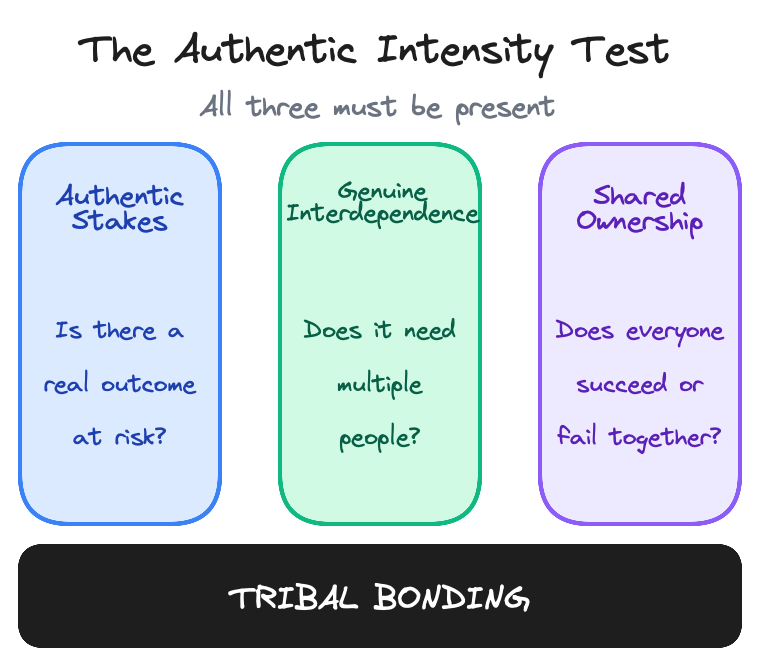
First, authentic stakes. Is there a real outcome at risk? Not fabricated deadlines, but something genuinely mattering to those involved.
Second, genuine interdependence. Does the work actually require multiple people's specific contributions? If one person could do it alone, tribal bonding mechanisms don't activate.
Third, shared ownership of outcome. Does everyone succeed or fail together? Individual metrics work against tribal formation. Collective outcomes create collective identity.
The Performance Theatre Trap
The risk is that organisations try to manufacture intensity. It fails predictably.
A 2023 Harvard Business Review analysis found many leaders unknowingly create chronic overwhelm. Constant "jumping" between tasks hinders progress while draining energy. When everything is urgent, nothing really is.

Authentic intensity comes from work that actually matters, with real consequences and genuine interdependence. Manufactured intensity comes from poor planning and leaders confusing busyness with importance. The first builds bonds. The second destroys trust.
The Bottom Line
The old regime treated workplace connection as an HR problem solvable through proximity policies and team-building budgets.
The new paradigm recognises that belonging is an intensity problem. Shared comfort doesn't create tribes. Shared struggle does.
That's not a small shift. It's a complete reorientation of how we think about what holds teams together. The organisations that understand this will build cultures of authentic challenge. The ones that don't will keep scheduling happy hours for people who feel lonelier with every passing quarter.
The irony is that AI, the technology most associated with isolation and job anxiety, might be the force that accidentally restores something essential. The productivity pressure creates intensity. The intensity creates interdependence. The interdependence activates bonding mechanisms that have been dormant where we have optimised work for individual output rather than collective survival.
The question is whether organisations recognise it and respond appropriately. Maybe we’ve finally found the killer app for the question as to why we should be returning to the office.
Until next time, you'll find me paying closer attention to which deadlines create energy and which ones just create email, and being slightly more grateful when technical problems force real collaboration.


Blooding the troops —> Esprit de corps.