The Tax on Intelligence: Why the UK Is Paying Four Times More to Think
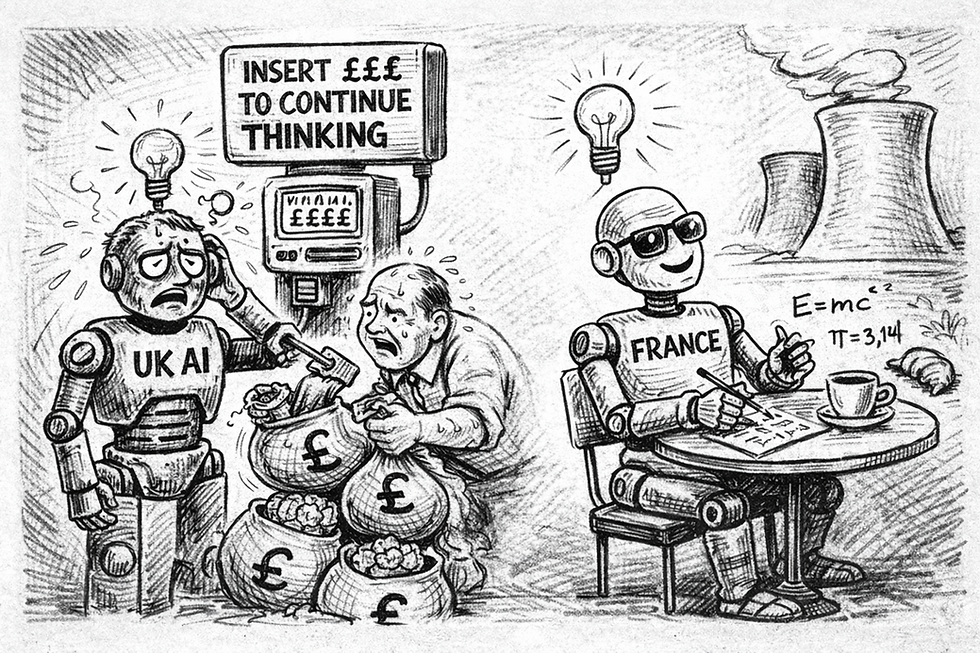
Last week I sat on a panel on AI for a private equity firm. There were some great insights around the state of AI in the wild from the CEOs, founders and other panellists in the sessions I managed to see and in the conversations over drinks afterwards.
One of the topics that discussions increasingly turned to is the energy premium we are paying in the UK and what that means about the cost of keeping our data centre lights on.
The Stakes Most People Miss
This blog is about why electricity will become the strategic chokepoint for AI sovereignty, and why the UK's energy costs represent an existential threat to its ambitions in artificial intelligence. Understanding this matters because the decisions being made now about grid infrastructure and energy policy will determine whether Britain develops its own cognitive capabilities or rents them indefinitely from server farms in Virginia and Marseille.
Unfortunately, most discussions about AI strategy focus on the wrong phase of the value chain. The headlines obsess over training costs for frontier models. But training is a sprint. Inference is a marathon. And marathons are where energy economics actually bite.
If we don't grasp this, we'll watch the economic value of the AI revolution flow offshore while Britain becomes a client state, paying perpetual rent on digital infrastructure owned by others. The Social Market Foundation (a UK think-tank) calculates that powering a 100MW data centre in the UK costs four times as much as an equivalent facility in the United States. That differential compounds every hour, every day, for as long as the models run.
The reality is that the UK's industrial electricity prices are (along with Germany and Italy) the highest of 28 countries tracked by the IEA. This isn't a market quirk to be managed. It's a structural tax on cognitive capability that has the potential to hollow out key parts of Britain's AI sector unless government acts with unprecedented urgency.
I'm going to show you why I think the training-cost narrative misses the point, what "intelligence security" actually means, and share with you where I am in thinking about what an ambitious UK strategy could look like.
With that, let's dive in.
Training Is a Red Herring.
For years, the AI energy debate centred on training. Headlines trumpeted that GPT-4 consumed 50 gigawatt-hours to train, or that frontier models now cost $500 million to develop. These numbers are real, but they're strategically misleading.
Training happens once. A company spends months and millions creating a model, then amortises that cost across years of use. But inference, the process of actually running that model to answer queries, generate content, and power applications, runs continuously. The MIT Technology Review now reports that 80-90% of AI's energy consumption comes from inference, not training. McKinsey puts a lower number on this but projects inference will account for two-thirds of all compute by end 2026, up from one-third in 2023.
A $500 million training run, however eye-watering, is a one-time capital expense dominated by GPU costs. Electricity is perhaps 5-10% of that total. But inference costs compound relentlessly. Every ChatGPT query, every AI-powered search, every enterprise copilot consumes roughly 0.3 watt-hours, around 7-10 times more than a traditional Google search. This can be 100 times greater for analysis of a long document. Scale that across millions of daily users, running 24/7 for years, and the electricity bill becomes a dominant factor.
In my three decades of banking and consulting, I've watched cost structures determine competitive outcomes. A 10% margin disadvantage is survivable. A 300% disadvantage, the (current gap between UK and US industrial electricity prices), is not. Every AI service running on British soil pays this premium continuously. Every enterprise deploying AI domestically handicaps itself against competitors in Texas or Toulouse.
The inference market is projected to grow from $97 billion to $255 billion by 2030 (and I would argue for several reasons this could be low-balling the true number). The question isn't whether AI will consume massive amounts of electricity. The question is whose electricity it will consume, and who captures the economic value.
Think of it like manufacturing in the 1970s. Countries with cheap energy built industrial bases. Countries with expensive energy became importers. We're watching the same dynamic play out for cognitive production.
But the economics are only half the story.
Intelligence Security: The Risk Nobody Wants to Discuss
If UK companies can't afford to run AI domestically, they'll run it on American hyperscaler infrastructure - AWS, Azure, Google Cloud. This isn't hypothetical. It's already happening. But we need to be precise about what this dependency actually means, because there are two distinct problems often conflated in these discussions.
The first is economic. When AI workloads run in data centres outside Britain, the jobs, investment, and tax revenue flow elsewhere. The expertise accumulates elsewhere. The supply chains develop elsewhere. France's €109 billion AI infrastructure play isn't primarily about sovereignty - it's about capturing the economic value of the next industrial revolution. Every gigawatt of AI compute that lands in Marseille rather than Manchester represents decades of compound economic advantage lost.
The second is legal, and it's harder to solve. The US CLOUD Act grants American authorities access to data held by US companies anywhere in the world. An AWS data centre in London is still subject to American law. Cheaper UK electricity might attract more hyperscaler investment, but those facilities would remain American-owned infrastructure on British soil. The legal exposure doesn't disappear - it just moves closer.
True sovereignty requires UK-owned infrastructure: domestic cloud providers, British-controlled data centres, AI systems subject only to British law. France in particular has grasped this, investing in alternatives like OVHcloud while building EU legal frameworks that explicitly define sovereign infrastructure as systems shielded from US extraterritorial reach. The UK has no equivalent strategy.
Fixing electricity prices solves the economic problem but not the sovereignty problem. Competitive energy costs would keep AI investment onshore, preserve jobs, reduce latency, and capture tax revenue. These matter enormously. But a nation running its critical AI systems - healthcare diagnostics, financial infrastructure, defence applications - on foreign-owned platforms remains a client state, regardless of where those platforms are physically located.
The economic case for urgent action on energy costs is overwhelming. The sovereignty case requires something more: a serious conversation about whether Britain needs its own cloud infrastructure, and whether we have the appetite to build it.
The Full Stack Problem
To be clear: electricity is not the only chokepoint. The AI sovereignty stack runs deeper. NVIDIA controls over 80% of the GPU market. The dominant cloud platforms - AWS, Azure, Google Cloud - are American. The frontier models powering the most capable AI systems are built by US companies subject to US law. Britain has no hyperscaler of its own, and a talent pipeline that increasingly drains toward Silicon Valley salaries.
Cheap electricity alone won't solve this. France isn't attracting AI investment solely because of €42 megawatt-hours - it's the full package: nuclear power, pre-identified sites, tax incentives, and EU market access combined.
But most of those dependencies are structural realities that will take decades to unwind, if they can be unwound at all. Britain isn't going to build a domestic GPU industry by 2030. It isn't going to create an AWS competitor. Those ships have sailed.
Electricity is different. The UK has generation capacity. It has a grid. It has policy levers that could be pulled tomorrow. Fixing the energy cost disadvantage won't guarantee AI sovereignty, but leaving it unfixed guarantees we won't even be in the conversation. You can't attract the hyperscalers, the investment, or the talent to build domestic capability when your operating costs are four times the competition. Electricity isn't sufficient for sovereignty. But it's necessary. And unlike the other dependencies, it's actually within our control.
What an Ambitious UK Strategy Would Actually Look Like
To be fair to the current government they are not blind to this problem. The AI Energy Council, established in April 2025, brings together regulators, tech giants, and energy companies. AI Growth Zones in North East England, Wales, and potentially Scotland offer electricity discounts where surplus grid capacity exists, with 500MW earmarked for each zone (versus roughly 100GW of total capacity for the UK). Rolls-Royce won the SMR competition in June 2025, with £2.5 billion committed to these small modular reactors.
These are sensible steps. Thinking through the various scenarios (well, I am a risk manager) they do not appear to be remotely sufficient.
Compare the UK's approach to France's. Paris has announced €109 billion in AI infrastructure investment. EDF offers pre-identified industrial sites with 2GW of available nuclear capacity. The ARENH mechanism provides nuclear electricity at €42 per megawatt-hour (although that arrangement is ending this year). Data centres receive a 50% reduction in energy taxes and a 30% R&D tax credit. FluidStack has signed for a 1GW AI supercomputer powered by French nuclear.
The UK's SMRs won't arrive until the mid-2030s. The current AI buildout is happening now. France is eating our lunch while we wait for reactors that won't generate electrons for a decade.
What would genuine ambition look like?
First, emergency pricing intervention. The AI Growth Zone discounts of £14-24 per megawatt-hour are welcome but inadequate when the commercial price can exceed £200. Some sort of sovereign AI tariff, offering nuclear-equivalent pricing for designated AI infrastructure, would close the gap with France immediately using existing generation capacity.
Second, strategic grid priority. The current connection queue contains 100GW of projects, with viable data centres waiting years behind speculative applications. Designating AI infrastructure as genuinely critical, equivalent to hospitals or defence installations, could unlock capacity that already exists.
Third, compute-for-equity deals. The government co-invests in new generation capacity. In return, hyperscalers guarantee a portion of resulting compute to UK public sector and research at cost. The National Wealth Fund exists precisely for strategic industrial investment. Arguably, this is the defining strategic industry of the next three decades.
Fourth, accelerated nuclear licensing. Rolls-Royce's SMR is "18 months ahead of competitors in the regulatory process." Eighteen months is too slow. Emergency licensing procedures, similar to those used for COVID vaccines, could compress timelines dramatically.
The alternative is already visible. ICIS (Independent Commodity Intelligence Services) analyst Luca Urbanucci notes that "the price differential is currently the main distinction between the French and UK markets in terms of data-center attractiveness." Capital flows to where returns are highest. AI infrastructure is flowing to France, to the Nordics, to anywhere but Britain.
The Bottom Line
The old model treated electricity as invisible infrastructure, always available, roughly equivalent across developed economies. Energy policy was about decarbonisation targets and consumer bills, not strategic industrial positioning.
The new reality is that electrons have become feedstock for cognitive production. The cost and availability of electricity determines where AI capability develops, who captures its economic value, and which nations maintain what I've called intelligence security. The UK's price per kilowatt-hour, the highest industrial rate in Europe, functions as a permanent tax on every AI operation conducted on British soil.
This isn't a problem that market forces will solve. France's nuclear fleet represents fifty years of strategic state investment. The UK's grid constraints reflect decades of underinvestment in transmission. Unwinding these structural disadvantages requires government action at a scale and speed that current policy doesn't contemplate.
The designation of data centres as Critical National Infrastructure and the creation of AI Growth Zones suggest ministers understand something important is at stake. But understanding is not acting. The gap between what's happening and what's needed grows wider every month that France attracts another gigawatt of AI investment.
Britain has a narrow window to act. The AI infrastructure buildout is happening now, with investment decisions being made in boardrooms this quarter. Once the hyperscalers commit their billions to Marseille and Stockholm, those electrons will power AI for decades. The sovereignty premium we'll pay as a client state, renting cognitive capability from others, will dwarf whatever it would have cost to build our own.
I did wonder whether the recent deals with Groq and Cerebras (and their reduction in power consumption along with faster inference) might be our saving grace. But two things are obvious. Firstly, everyone gets the efficiency (ignoring supply constraints) so the relative competitive position is unchanged. Secondly, Jevons paradox (which I’ve spoken about before) might mean that whilst we could get a 10x efficiency gain from new chips, we get 20x in demand.
UK-bashing has become fashionable of late. I’m not a fan. But what I will say now is, without a solution as to how we provide energy and infrastructure for the UK’s AI strategy, we will i) be at a competitive disadvantage for UK industry, and ii) we will be strategically dependent on fragile international favours for AI provision.
Until next time, you'll find me wondering whether we’ll take action before we realise that we are paying other countries to do our thinking for us.


Comments